Residential Junk Pricing: Trailer Sizes and Load Costs
Wondering what a junk trailer load really costs? We break down our 6x12 dump trailer, load sizes, and real-world pricing so you know exactly what to expect.
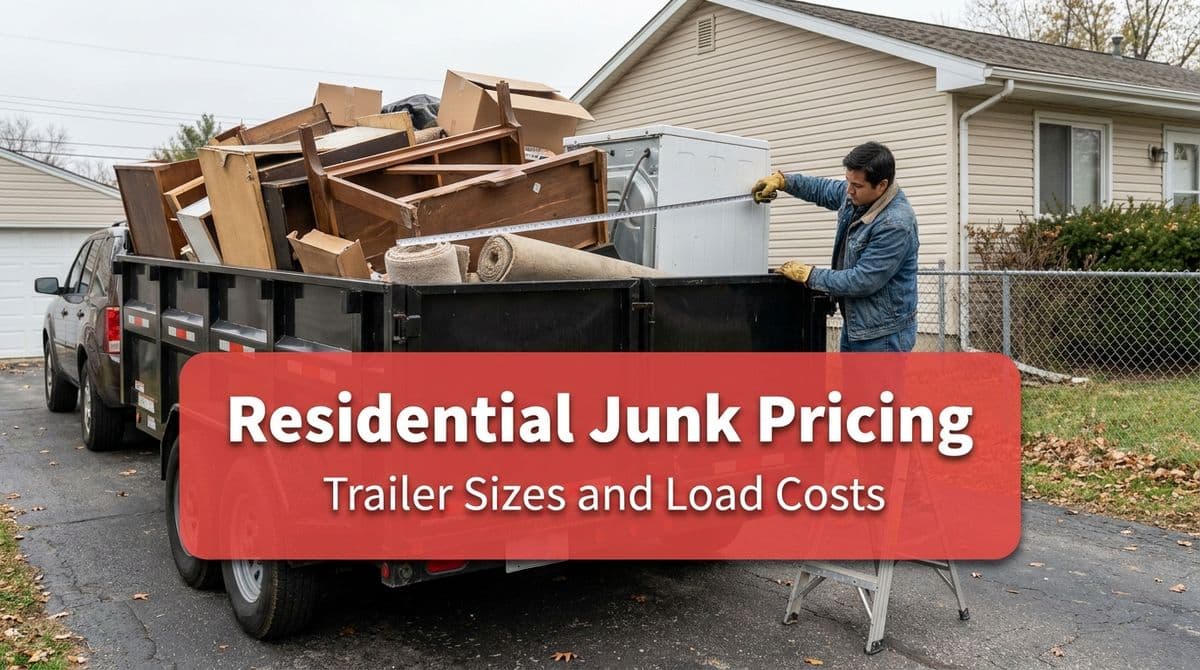
How Our Residential Junk Pricing Really Works
We recently got a call from a homeowner — we’ll call her Kelly — who had just moved into a new place. Her garage was packed with moving boxes, contractor bags, old light fixtures, and random debris from unpacking and small remodel projects.
Her first question to us was simple: “How do you all work? Do you just have a truck, and what does it cost to fill it up?” From there, we walked her through exactly how our trailer size, load estimates, and pricing work so she could decide what to keep, what to toss, and what to budget.
Since we get these same questions a lot, we thought we’d share the same breakdown we gave Kelly, so you know what to expect before we ever pull into your driveway.
Our Trailer Size and How Much It Holds
First, let’s talk about the equipment, because that affects everything else — especially pricing.
We use a single standard dump trailer for residential junk jobs. It’s:
- 6 feet wide
- 12 feet long
- 4-foot-high walls
In plain English, that’s a pretty big trailer — roughly comparable to a small dumpster. The big difference is that instead of dropping a container in your driveway and leaving you to fill it, we load everything into the trailer for you.
For most homeowners, a full trailer like this can handle:
- A packed single-car garage worth of typical household junk
- Post-move debris: boxes, packing material, light fixtures, and small furniture
- General clean-out from a basement or a couple of rooms
“Will My Stuff Blow Out?” How We Handle Boxes and Light Items
One of Kelly’s big concerns was that her cardboard boxes and lightweight items might blow out of an open trailer on the way to the dump. It’s a fair question — nobody wants their moving boxes scattered down the street.
We explained that while our dump trailer isn’t fully covered, we load it thoughtfully and securely. That means:
- Lighter items and boxes go in first, along the bottom and toward the front
- Heavier items are stacked on top to weigh everything down
- We pack tightly to avoid gaps where things can shift or lift in the wind
In other words, we don’t just toss things in and hope for the best. We load in a way that keeps your neighborhood clean and your junk contained until it reaches the disposal site.
Our Simple, Tiered Pricing by Trailer Load
Once Kelly understood the trailer size, her next question was the one everyone wants answered: “What does it cost to fill that up?”
Our pricing is straightforward and based on how much of the trailer you use. We break it down into quarters so you only pay for the space you actually fill:
- Quarter trailer (¼ load) – $150
- Half trailer (½ load) – $300
- Full trailer (full load) – $600
We rarely run into confusion with this system because it’s easy to picture your junk in “slices” of the trailer. If we load up and it only fills three-quarters of the space, you won’t be charged for a completely full load.
Real-World Examples of What You Might Pay
Every situation is a little different, but here are some common scenarios to give you a ballpark idea of what you might expect:
- Light post-move cleanup (mostly boxes & bags)
Often falls between a ¼ and ½ trailer, so you’d be looking at around $150–$300, depending on how much is actually there. - Garage clear-out of stored junk
Old holiday decor, small furniture, totes, and random “we’ll deal with it later” piles commonly land in the ½ to ¾ trailer range — roughly $300–$450. - Big clean-out or move-out
If you’re emptying a loaded single-car garage or doing a whole-room clean-out, it may use the entire trailer, around $600.
With Kelly, everything was still in her garage and she wasn’t sure how it would add up, so we gave her one more option to get clarity before scheduling.
Texting Photos for a Quick Price Estimate
We know it can be hard to eyeball a pile of junk and translate that into quarters of a trailer. That’s why we encourage homeowners to text us photos of what needs to go.
Here’s how that helps:
- We can usually estimate whether you’re closer to ¼, ½, ¾, or a full load
- We can spot any unusual items that might affect space or weight
- You get a realistic price range before we show up
With Kelly, we suggested she organize everything she wanted gone into one area of the garage, then text us a few clear pictures. From there, we could say something like, “This looks like about half to three-quarters of the trailer,” and give her a tighter estimate.
What to Expect on Junk Removal Day
Once you’re ready to book, we’ll set a day and time that works for you — usually within a day or two for typical residential loads, just like we offered Kelly.
On the day of service, here’s what you can expect:
- We arrive with our truck and dump trailer
- You point out everything that needs to go
- We do all the lifting and loading into the trailer
- We pack it securely so nothing shifts or blows out
- We confirm the final load size (¼, ½, ¾, or full)
- You pay based on the actual space used — no surprises
By the time we pull away, your space is cleared out, and you know exactly what you paid for and why.
Ready to Clear Out the Clutter?
Whether you’re staring at a garage full of moving boxes like Kelly or finally tackling that long-put-off clean-out, our goal is to make junk hauling simple, transparent, and predictable.
If you’re unsure how much space you’ll need, gather everything into one spot and send us a few photos. We’ll walk you through how it translates into trailer space and cost, so you can make a confident decision before we ever back into your driveway.