Junk Removal vs. Renting a Dumpster: Full-Service Hauling
Not sure whether to rent a dumpster or hire full-service junk removal? Here’s how full-service hauling works, what it costs, and when it’s the better choice.
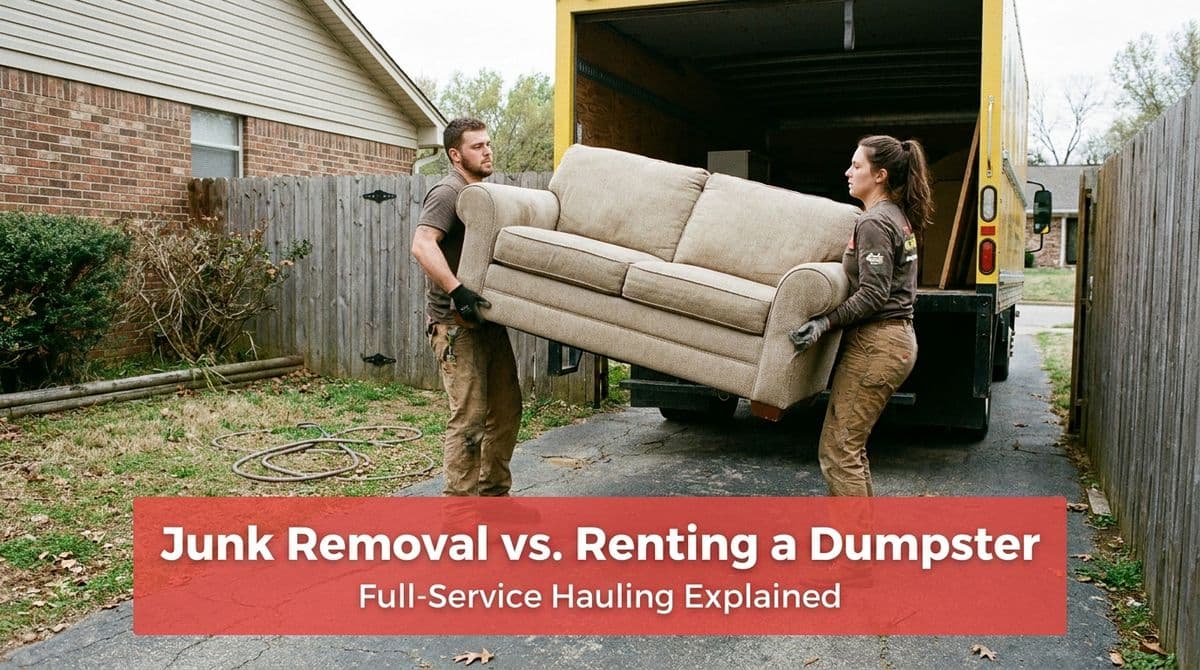
Junk Removal vs. Renting a Dumpster: What Really Works Better?
We recently got a call from a customer — let’s call her Kelly — who had done almost everything right. She’d cleared out most of her storage unit on her own, but she’d hit a wall with the last few items: a huge dresser, a jelly cabinet, an oak entertainment center, an oak coffee table, and a couple of bags of trash she couldn’t fit in her car.
Her questions were simple, and ones we hear all the time:
- “Can you come to my storage unit?”
- “Will you actually load the heavy furniture for me?”
- “Is this better than renting a dumpster?”
- “Can you donate the good pieces instead of dumping them?”
Those questions are really at the heart of the junk removal vs. dumpster rental decision. So in this post, I want to walk you through exactly how our full-service hauling works, what we actually do on-site, and when it’s usually a better option than renting a dumpster.
What Is Full-Service Junk Removal, Exactly?
With Kelly, I explained it the same way I always do: we show up with a big trailer, you point at what needs to go, and we do all the lifting and loading.
That’s the core of full-service junk removal:
- We come to you (homes, storage units, apartments, offices).
- We provide the truck/trailer — no need to rent or drive anything.
- We do the labor: carrying, lifting, loading, and sweeping up.
- We dispose of or donate your items the right way.
For storage units like Kelly’s, that means you don’t need to move items to a driveway or curb. We go right into the unit, maneuver the big pieces out, and load them safely.
How It Works Step-by-Step (From Your First Call to the Final Sweep)
Our process is simple, but there are a few key steps that help you know what to expect and what it might cost.
1. Photos and a Rough Estimate
On the call, I asked Kelly to text me pictures of the unit and the items: the dresser, jelly cabinet, entertainment center, coffee table, and bags of trash. Photos help us estimate volume and difficulty so we can give you a ballpark price range before we even show up.
If you’re planning a cleanout, you can usually send:
- Wide shots that show how much space is filled
- Closer photos of heavy or unusual items (pianos, safes, armoires, etc.)
2. On-Site Quote Before We Start
When we arrive, we walk the space with you, confirm what’s going and what’s staying, and then give you a firm on-site price before any loading starts. If you approve it, we get to work right away.
3. We Do All the Lifting, Loading, and Sorting
For Kelly, this was the deal-maker. She told me straight out, “I can’t lift this stuff into a dumpster anyway.” That’s where full-service shines. We:
- Carry items from where they sit — unit, basement, upstairs, etc.
- Handle the heavy lifting and tight corners safely
- Load the trailer efficiently so you’re not paying for wasted space
We don’t usually have time to sort every single item on-site, but we do keep an eye out for usable, donatable furniture.
4. Donation, Recycling, and Responsible Disposal
Kelly was very clear that her furniture wasn’t “junk junk.” It was solid oak pieces that still had life in them. She specifically asked if we donate, and the answer — as I told her — is yes, when we can.
Here’s what we typically do with your items:
- Good, usable furniture: Donated to local charities, churches, or families we know need it
- Electronics/TVs: Taken to proper e-waste facilities when required
- Trash and non-usable items: Hauled to the landfill or transfer station
We can’t guarantee every item will be donated, but we actively try to find the best home for decent pieces instead of just dumping everything.
What Affects the Price of Full-Service Junk Removal?
Kelly wanted a quote, just like most people who call us. While every job is a little different, here are the main factors that impact cost:
- Volume – How much space your items take up in the truck or trailer
- Weight – Especially heavy items can affect fees at the landfill
- Access – Long walks, lots of stairs, or tricky parking can add labor time
- Location – Distance from our base and local disposal fees
- Special items – Things like old TVs or hazardous materials may have extra costs
We price by how full the trailer gets, not by how “nice” or “junk” the items are. Like I told Kelly, whether it’s good or bad, it’s really about space and labor. If it’s really good, we’ll do our best to donate it, but that doesn’t usually change the price.
Full-Service Junk Removal vs. Renting a Dumpster
So when is hiring a crew like us better than DIY dumpster rental? Kelly’s situation is a textbook example.
When Full-Service Junk Removal Is Usually the Better Choice
- You can’t safely lift or move heavy items (furniture, appliances, large boxes)
- You’re dealing with a storage unit or apartment where you can’t place a dumpster
- You want it done in one visit instead of a dumpster sitting in your driveway for days
- You care about donation and want usable items to go to a good home
In these cases, the convenience and reduced labor of full-service hauling often justify the cost — especially when you factor in your time, potential injury risk, and the hassle of arranging a dumpster.
When a Dumpster Rental Might Make More Sense
Dumpster rentals can still be a good option in some situations, like:
- Slow, ongoing projects (remodels, long cleanouts) where you’re filling it over a week or more
- Lots of loose construction debris you can easily toss yourself
- You have help and equipment to move heavy items safely
Just remember: with a dumpster, you’re handling all the labor yourself, and you still pay for the container even if you don’t fill it completely.
Cost, Convenience, and Labor: A Quick Comparison
- Cost: A full-service junk removal job may be similar in price to a dumpster rental once you factor in delivery, pickup, and extra fees — but with us, loading and cleanup are included.
- Convenience: We show up, load, sweep, and go. No permits, no long-term dumpster sitting outside, no guessing what size you need.
- Labor: With full-service hauling, you don’t lift a thing. With a dumpster, you’re the crew.
Not Sure Which You Need? Here’s a Simple Rule of Thumb
If you’re looking at your situation and thinking, like Kelly did, “I have no way to move this stuff,” that’s usually your answer — full-service junk removal is probably the better choice.
If you’re tackling a long project, comfortable doing the lifting, and mainly dealing with light debris, a dumpster might work just fine.
Either way, sending photos and talking through your situation with a local junk removal company can help you make the right call — and avoid getting stuck with furniture you simply can’t move.